
Originally published in portuguese in 01/09/2017
Trying to understand the cultural changes that an ancient practice has undergone over time is extremely fascinating. Everything from the now seems to make the most sense when you are at peace with yesterday. Much of what defines our current behaviors can be explained by past practices. Even so, at times, I feel that big and small developers in Brazil today take little advantage of our culture that is so rich and vast.
The local indie game scene, out of fear or inexperience, seems to distance itself from folkloric symbols – either because it can no longer bear to hear jokes about games with Saci-Pererê, or because its most prominent creators have no proximity to the subject, unless some dragged lessons from the distant high school days.
Trovadorismo (also known as Galician-Portuguese lyric), the first literary movement in the Portuguese language, consisted of medieval songs performed by artists wielded by a lute or cistre, from the beginning of the 12th century to the middle of the 14th century. Over time, this oral culture ended up being transformed into writing through small publications of songs that became popular. These publications arrived in Brazil in the same boats as the colonization, becoming more popular in the 1800s and in the Northeast region. The practice of woodcutting also came together, since that was how illustrations were made. The leaflets earned the nickname “cordel”, due to the way they were exposed: hung by a cord in markets, squares and newsstands.
Establishing its roots in Portuguese troubadour, the cordel is the most Brazilian proof that extract concepts, inspirations, references from the folklore of your own country can result in something unique and relevant. After much study and consideration, this was the conclusion that developer Pedro “Pidroh” Furtado drew when making his game Daily Espada.
The 25-year-old from Ceará began to develop games using RPG Maker 2000 and improved his knowledge at the Faculty of Teleinformatics Engineering at the Federal University of Ceará. Although he has already developed some smaller games for mobile phones, his first real challenge was with Daily Espada, made in 2015. At the time, he started voting on Steam Greenlight and Pedro has already launched a new version, correcting the technical problems of before.
Pedro published an article on Gamasutra in which he invited other fellow developers to follow a route of more local flavors and research about his own culture. In the game, we have a bizarre version of a reality show where people fight monsters to win prizes and fulfill their dream of home ownership, for example. At first glance you realize that the monsters are inspired by braziliand folkloric creatures, such as the Headless Mule and Saci-Pererê.
“I wanted to make an action game focused on boss fights, with a simple and cohesive art”, comments the developer, who amends: “But the fact that the main character can transform is because I like Kamen Rider very much”.
Interestingly, his inspiration did not come from reading dusty books that are part of the mandatory material of the school’s Portuguese classes. In addition to Monster Hunter and Kamen Rider, the main influence comes from the Japanese RPG series Shin Megami Tensei (SMT), with emphasis on the way in which the series uses folk elements from the Greco-Roman, African, Inca, Irish, Egyptian cultures and many others. The series was never about these beings themselves, but uses them as a source of inspiration and sometimes inserts metaphors connecting the original tales to the game’s narrative.
If we look at the big spectrum, what Pedro remarks is something experienced by many developers with different approaches. Little by little, it is a practice that has yielded good results for some.

“Never Alone: Kisima Inŋitchuŋa emerged as a way to share Alaska’s indigenous culture (Iñupiaq) in a progressive and innovative way.” Tells Alan Gershenfeld, co-founder of E-Line Media, developer of the game in an interview with Wired UK. “We took three months to understand how the indigenous population is portrayed in various media. In cinema and music it is possible to find several examples of success, while in video games it is not. We wanted to develop something powerful and authentic”.
The game was made in partnership with an NGO that works with indigenous peoples from Alaska and other regions of America, the Cook Inlet Tribal Council. In it we control little Nina and her arctic fox in an adventure game with puzzles and in a cold atmosphere.
In a way, the Iñupiaq culture explored in the game not only presents a universe unknown to the general public, but also brings together those who are already familiar with it. It works as a connection with such a culture, that’s what William Dubé, Jotun’s creative director, tells me.
“There are a ton of people out there who are great fans of the myths and also people for whom it is a religion. If we can respect the mythology in a way that brings it to more people, that’s great! If we can introduce gamers to just how awesome this mythology is, we’ll be very proud of ourselves”.
William Dubé
In Jotun, we play as Thora, a Nordic warrior who died miserably and needs to prove to the gods that she is worthy to enter Valhalla, a worthy place where warriors go. Exploring Nordic mythology is not new, what differs here is the effort to create a unique experience using certain cultural elements.
Pedro says that in the first week he had already defined that the enemies would be based on Brazilian folk creatures. He also says that it was something very natural, arising when he was thinking about a theme that would unify the bosses, so he thought it would be interesting to insert elements of his own culture. Throughout the conversation, I could hear the enthusiasm in his voice every time he mentioned Shin Megami Tensei. It is the biggest inspiration for the Daily Espada, mainly because it encompasses diverse cultures, without actively pushing ideologies, without sounding like a big boring history class.
“It is interesting how SMT uses the different mythologies of the world,” he said. “In the main series you can have an alignment, like ‘chaos’ for example, that gives you the chance to fight side by side with Lucifer to tackle terror. That was wonderful.” Pedro emphasized, filling with smiles.
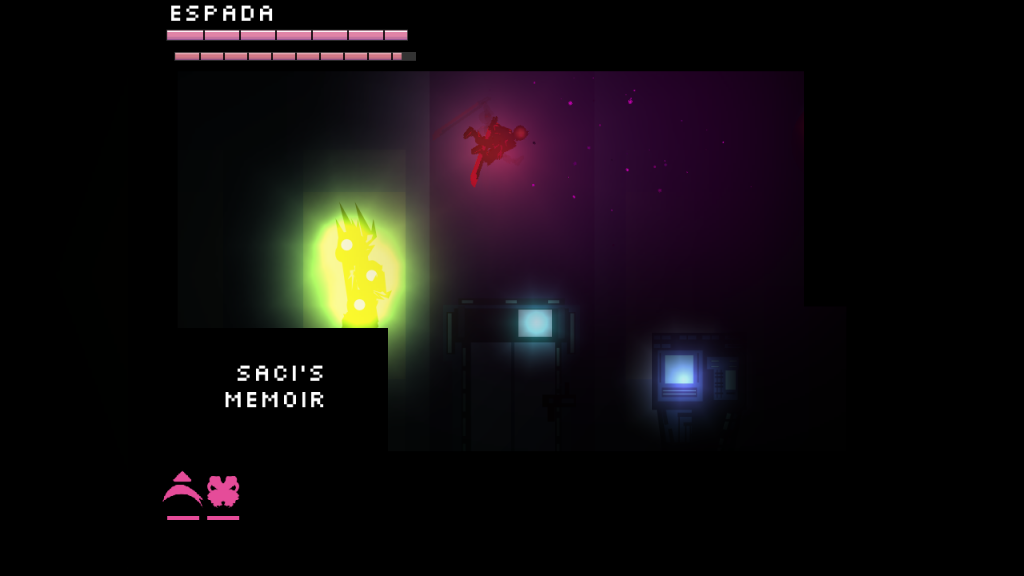
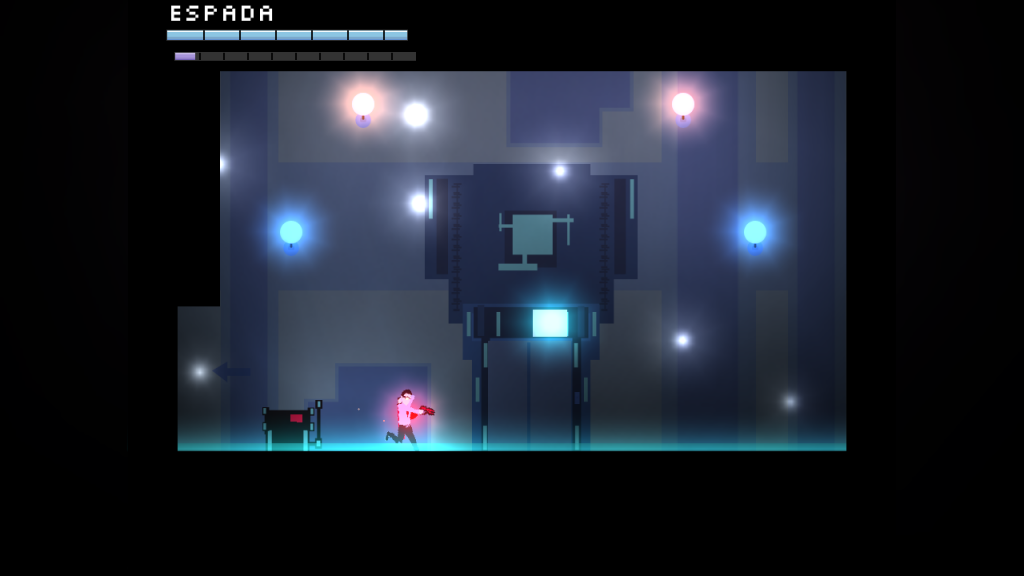
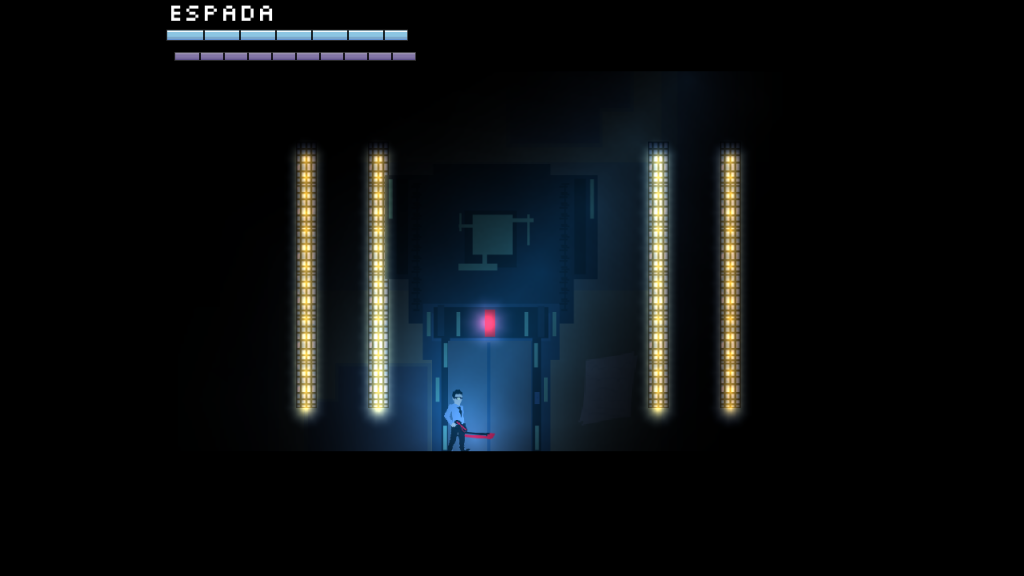
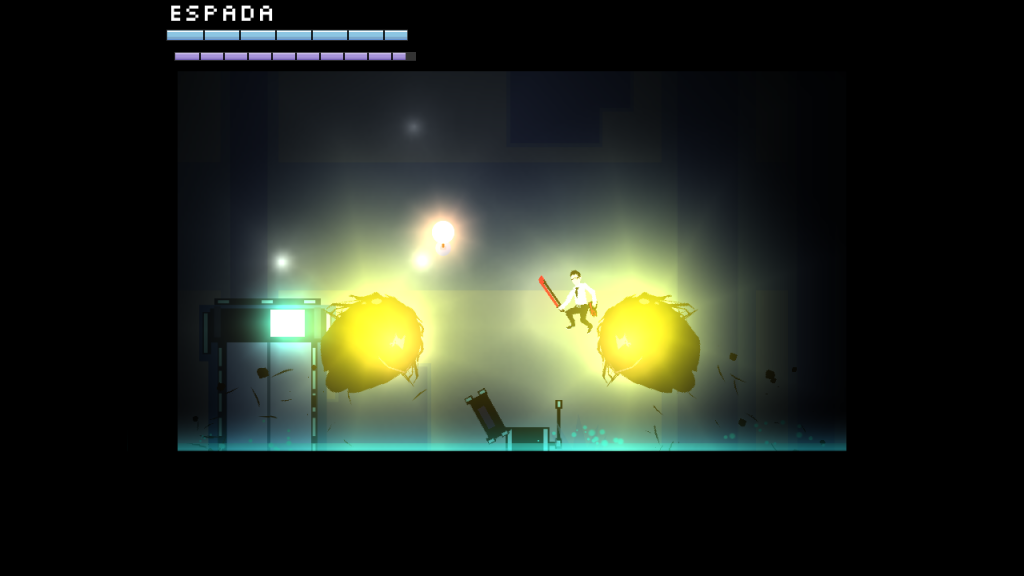
The idea for the Daily Espada came from playing Persona 4, an SMT spin-off. “I found myself discovering new things in Japanese mythology that are unknown to the general public. It was not a game made to teach, he is very competent and fun in his proposal. By exposing certain elements, you learned something new without meaning to. With my game, the objective was to try to convey the same feeling, to show that Brazilian culture is quite interesting”.
A good example is at the beginning of Persona 4, since the first persona (one of the monsters he can control) that the player receives is Izanagi, who in Japanese mythology was the deity who built the archipelago of Japan together with his wife, Izanami.
Dubé tells something similar about transposing the stories in Jotun.
“You have Thor dressing up as a bridesmaid to smash a giant’s skull in, a cow with poison rivers coming out of her udders, and so many more crazy stories. Integrating these stories through level design, boss design and visual storytelling is a very interesting challenge”.
William Dubé
In Daily Espada, each boss has his own floor and, in addition to the files that the player can read to know the origin of the monsters, the floors capture part of each creature’s theme. “The most attractive thing for me when reading the legends are the most real and heavy aspects, like the Mule’s religious origin and Saci’s slave-origin”.
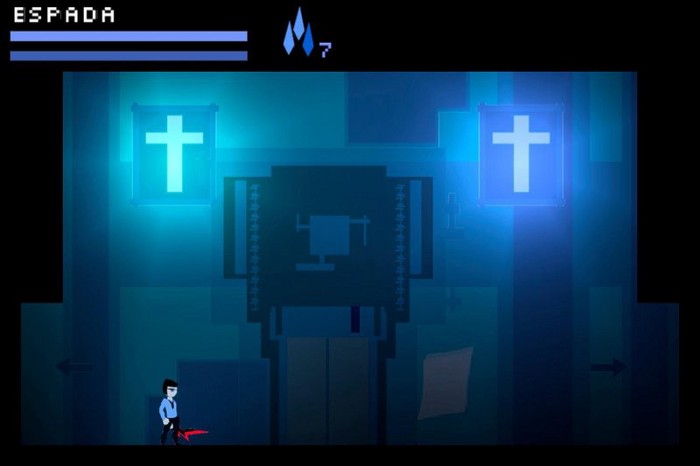
In the Headless Mule room, we can see Christian symbols, like the cross on the walls. It is a direct reference to one of the origins of the legend, where the Mule represents divine punishment for a woman when she decides to have a relationship with a priest. It is worth remembering that there is no definitive origin for the creatures of Brazilian culture. The stories were told in word-of-mouth, so each person told their own way from a different perspective.
The origin of Saci-Pererê is a good example of this mess. In one story he is an indigenous child, protector of the forest who, in this version, had two legs. When the slavery got stronger in Brazil, slaves used to tell stories about this black boy who cut off one of his members because he preferred to be a free legman than a slave with two legs. Many believe that it was this version that inspired Monteiro Lobato to create the most popular Saci we know today.
Translating these concepts into a game was a very organic process for Pedro, everything was done through tests, trying to understand what worked and what didn’t. He says that Saci is a playful figure, who likes to play tricks, so it was natural to put fake doors in his room creating a small puzzle. When you fight against him, the mischievous one-leg creature can drop projectiles through his pipe and can teleport through the smoke.
The same happened with Cuca. “Cuca is a character that transmits fear, it is the Brazilian bogeyman who eats children. I wanted to convey that feeling in her room, so I put some children with a huge fear of becoming food”, says Pedro.
In the first enemy of the game, nicknamed ‘Colonizer’, the objective was a little different. The idea was to demonstrate a little bit of the consequences of the colonial period in Brazil. “It came from the school’s history classes,” he commented. “It was something that stuck with me, this notion of how colonization shows the difference in the development of countries and can be the source of many of the problems we have today. I thought it was important to bring that concept to the game ”.
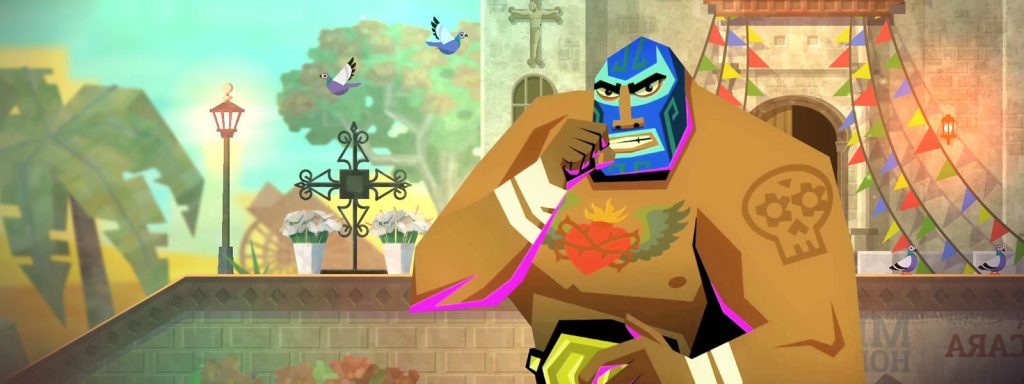
“The process is like a giant funnel where you keep throwing game ideas and Mexican themes and hopefully they end up merging seamlessly at the end”. Says Augusto Quijano, Concept Lead at DrinkBox Studios.
He is also responsible for the look of Guacamelee! And it seems to share the same process as Pedro. The idea for the game came from missing his hometown and he wanted to portray it in his next project.
“I had moved to Toronto 5 years prior to Guacamelee and found myself craving the mundane things about Mexico that I experienced growing up” tells Quijano. “The second one was how Mexico was portrayed in the media. It was an outsider’s perspective of Mexico and I felt that although there are a lot of bad things about it, no one is showing the full picture, or the good side, the one I missed”.
Alejandro also says that in game development, mechanics come first and then try to look for something that is Mexican. “These are things I wanted to show you from Mexico. Like having geographic diversity and color, and not just having a sepia desert. Ruins, folklore, alebrijes, etc…”
Looking more generally at games made in Brazil, although few, we already have relevant examples that bring this folk culture to games, despite doing it in a much less direct way than in Daily Espada. Just see Aritana and the Harpy’s Feather, which explores Brazilian indigenous culture, or Xilo and Cangaço, who have more comprehensive approaches to national mystique.
“[The problem is that] making a game is a risk in itself,” says Pedro. “Inserting elements of folklore is a greater risk, it is difficult to generate returns because the public’s interest is minimal. You have to make a game that supports itself, that is good regardless of the theme you want to bring.”
For him, Daily Espada is a way for people to have access to a culture that is not so widespread. Even so, not everyone is willing to take that risk, which reminded me of the mongrel complex that we like to say that every Brazilian has, commenting on this, Pedro points out: “the normal thing for Brazilians is to trash talk the country, that nothing works, that only has a thief. Those who say they are proud to be Brazilian sometimes only say it to individualize themselves, to go against the tide”.
“I think is ridiculous to think a person can’t relate to a character simply because they’re not from the same culture”.
Alejandro Quijano, concept lead at DrinkBox
On the other hand, Pedro also thinks it is wrong to push customs down his throat, as if it were an obligation. His Gamasutra piece only came about because it really felt good to do the research and suggests that some developers do the same.
“[To use elements from other cultures is] valuable because games have the ability to put you in other people’s perspective. I think the world needs more of that.”, agrees Quijano.
It is understandable to distance this generation of artists and creators of a colonial culture in an increasingly urban and independent Brazil. But there is no better opportunity to foster folklore than to relive it in an environment as inviting and experimental as that of independent games. “We don’t have a cultural identity geared to nationalism, to like the country. We do not encourage this idea. Perhaps a Globo soap opera or a fantasy author can help spread classic cultural elements in a current context, ” suggests Pedro. “Why not do it?”.